
Tom de Jong
Postdoc at Radboud University, previously at University of Nottingham, working on type theory. PhD from University of Birmingham. Mathematician, computer scientist and runner.
Postdoc at Radboud University, previously at University of Nottingham, working on type theory. PhD from University of Birmingham. Mathematician, computer scientist and runner.
What a fantastic talk by @amy:
CATEGORY THEORY FORMALISED HUMANELY
https://media.ccc.de/v/qtcat-2026-110771-category-theory-formalised-humanely
I am looking forward to watching some of the other qtcat talks too.

Very interesting experiment by Nihar B. Shah, who contacted authors of ten Transactions on Machine Learning Research (TMLR) submissions slated for desk rejection, and asked them to explain their submission over Zoom.
One frightening statistic from the article: "The fraction of desk rejected papers at TMLR used to be about 6% in 2023 but is now at about 53%."
https://medium.com/@TmlrOrg/asking-authors-about-their-own-papers-3d2e04e5dee0

A message from my colleague Benedikt Ahrens:
Hi all,
I have funding for a postdoc position at TU Delft on combining computer proof assistants and computer algebra systems in the area of category theory, and I would be happy to hear from potential applicants before the formal advert goes out.
I am looking for someone who is interested in all three of proof assistants, computer algebra systems, and category theory, and who has some experience in at least one or two of them.
The position ideally starts no later than March 2027.
If you are interested, please email me at B.P.Ahrens@tudelft.nl with a short note about your background and your research interests. Informal questions are very welcome.
Please feel free to forward this to anyone who might be a good fit.
Best wishes, Benedikt

I'm hiring a postdoc! Please share broadly with potential candidates.
I'm looking for someone with expertise in PL, FM, and/or networked systems who is excited about contributing to a research and teaching in a growing lab.
Suffice to say, EPFL is an incredible university and Lausanne is a great place to live and work!


This week the #HoTTEST seminar presents:
Meven Lennon-Bertrand (@mevenlennonbertrand)
What it takes to verify a kernel and a new way to prove it
The talk is at 11:30am EDT (UTC-4, = 15:30 UTC) this Thursday, September 24 and will be 60 minutes long, followed by up to 30 minutes for questions. The Zoom link and other information is available at https://hottest-seminar.github.io. All are welcome!
Abstract:
Dependent type theory is maybe the most expressive logic currently available. It is particularly good at letting its users directly and naturally express their mathematical ideas, without going through complicated encodings. However, this comes at a cost for those who build proof assistants based on type theory: constructing a kernel, the part of the system dedicated to checking a proof's correctness, is not an easy task! In this talk I'll give an overview of the difficulties one faces when trying to verify the correctness of such a kernel, in particular how I have come to view a set of properties I call *definitional inversions* as particularly critical. I'll also show a new approach, via domain theory, to establish these properties.
@mevenlennonbertrand @MartinEscardo coming back to this with an interesting blog post: https://fedi.aria.dog/objects/f5782f7c-5204-4921-a4d5-f29d2f72939c
The slides for my course in homotopy type theory / univalent foundations at the Proof and Computation autumn school are available at:
https://tdejong.com/talks/PC-2026-1.pdf
https://tdejong.com/talks/PC-2026-2.pdf
https://tdejong.com/talks/PC-2026-3.pdf
As always it was a great pleasure to be a part of this school, which saw its 10th anniversary!
https://www.mathematik.uni-muenchen.de/~schwicht/pc26.php
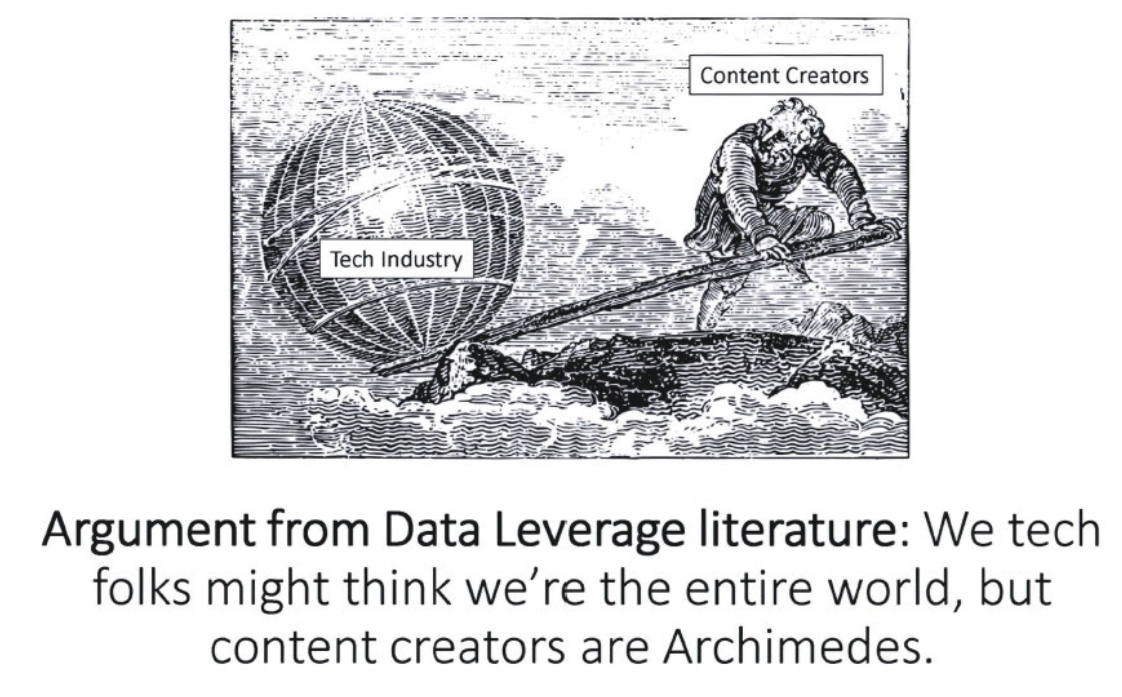
I'm not big on legalese but nevertheless I found this court document [1, found via [2]], and the quotes from people in the tech industry, quite interesting.
Example: "Microsoft has observed that “threaten[ing] the economic foundations of its essential suppliers … is an inherent outcome of creating LLMs with our current content strategy: LLMs are useful because they replicate the patterns in their training content which, without ways of distributing economic value down the content supply chain, necessarily threatens the economic sustainability of those who create the content.”
Yet AI companies remain powerless to break out of this “doom loop” because, while the industry as a whole would benefit if every company paid to sustain the continued production of the creative works their technology depends on, each individual company is better off taking content for free while others pay. Finding that copying news for AI is not fair use would solve this prisoners’ dilemma by putting all AI companies, OpenAI and Microsoft included, on an even footing. As Microsoft’s Dr. Glen Weyl put it, compensating creators is “in the best interests of my employer, of my country, and of many other groups I belong to.” An illustration from a Microsoft document that is worth a thousand words shows why: [attached]"
[1] https://storage.courtlistener.com/recap/gov.uscourts.nysd.640396/gov.uscourts.nysd.640396.1977.1.pdf
[2] https://tldr.nettime.org/@tante/117291064056626215 by @tante (via @gallais)

@de_Jong_Tom @MartinEscardo is the question how you can anonymously ship HTML pages? The service does that for you now! The link is https://anonymous.4open.science/api/repo/yourreponame/file/yourpathinyourrepo/bla.html
That means you can put your development there and link from the pdf to HTML pages hosted there now
@MartinEscardo https://anonymous.4open.science/
(I'm not sure how to best handle the HTML.)

The Fall 2026 HoTTEST lineup
The HoTTEST organizers are pleased to announce the Fall 2026 lineup for the Homotopy Type Theory Electronic Seminar Talks (HoTTEST). The speakers are:
Sep 24: Meven Lennon-Bertrand
Oct 8: Steve Awodey
Oct 22: Chuangjie Xu
Nov 5: Owen Milner
Nov 19: Daniël Otten
Dec 3: Owen Lynch
The seminar will meet on alternating Thursdays at 11:30 Eastern Time. For the first three meetings of the seminar this means Eastern Daylight Time (11:30 EDT = 15:30 UTC), while for the final three meetings this means Eastern Standard Time (11:30 EST = 16:30 UTC).
For updates and instructions how to attend, please see:
https://hottest-seminar.github.io/
Titles and abstracts will be announced shortly before each talk on the hott-electronic-seminar-talks list. Please join if you'd like to receive those announcements:
https://groups.google.com/g/hott-electronic-seminar-talks
For the organizers: Carlo Angiuli, Dan Christensen, Tom de Jong, Emily Riehl.
#HoTT @carloangiuli @de_Jong_Tom @emilyriehl
@dif If it's essentially a direct translation from the paper proof, the novelty is very limited in my opinion, but you may disagree of course.
@jonmsterling writes "I don't feel too strongly about the thesis artefact, but I do feel strongly about writing".
In fact, part of doing a PhD is learning how to write scientific/mathematical work.
Moreover, when you write anything, just the process of writing expands the ideas you had in your head. This happens to me every single time I write a paper, in which I end up proving more things than I originally intended, sometimes because one idea leads to another, and sometimes because I need these auxiliary results to write a better story behind the main ideas that were already there before the writing process started.

Yesterday, I started a new job as lecturer in mathematically structured programming at Strathclyde. It's sad to leave Nottingham, of course, but I'm also very happy to be back in Glasgow!
The future of my Nottingham email is currently very uncertain, so please replace 'nottingham' with 'strath' if you want to reach me from now on:-)
I would like to dedicate this paper to Gordon Plotkin for his 80th birthday, which is being celebrated this week at Edinburgh, and sadly I am missing, for the following two reasons.
(i) It was when I read his seminal paper "LCF considered as a programming language" [0] in, I think, 1989, or in any case the early 1990's, that I saw that in a very simple case we can computably existentially quantify over an infinite set to get a total answer, with his ∃ quantifier to get, together with parallel or, the Turing completeness of PCF.
At the same time, somebody who had been at Imperial, Benedito Acióly, gave me a photocopy of the draft version of Mike Smyth's chapter "Topology" [1], full of handwritten corrections by the author.
This made me think that the computability/continuity of Plotkin's existential quantifier had to do with the fact that domains are compact in their Scott topology. Then I investigated a further example, the domain of lazy natural numbers, and concluded that you can continuously/computably quantify over the maximal elements, which, under the Scott topology, are nothing but the main protagonist of the paper advertised above, ℕ∞, the one-point compactification of the discrete natural numbers.
I wrote an embarrassing paper about this, which I nevertheless share [2]. It is full of English typos and naivety.
The rest is history, as they say. If it had not been for Gordon's paper and his PCF existential quantifier [0], I would have never ever come up with the results of the paper advertised in this thread, even if the connection is rather thin.
(ii) doesn't fit in this post, and neither does the bibliography - continued below...
/5
@MartinEscardo There's an extra "not". It says "A map that is *not* nonsurjective is called extremely dense [...]".