
The wealth gap between rich millennials and the rest of their age group is the largest of any generation - A new class war? Spotted on CNBC, summary of @VanWinkleZachary et al. paper https://www.cnbc.com/2024/04/26/wealth-gap-between-millennials-new-class-war.html
"Does Family Structure Account for Child Achievement Gaps by Parental Education?" (England, France, Germany, United States). Inequalities by maternal education in children's math and reading skills using harmonized, longitudinal, and nationally representative surveys. Anne Solaz, Lidia Panico et al. https://doi.org/10.1111/padr.12623
Revive a research programme based on the integration between social policy & international political economy -> geared at critically assessing issues related to gender equality, employment and redistribution. Emanuele Ferragina revisit the ‘two lives’ of Esping-Andersen - Welfare State, Demographic Turn and some key concepts: Decommodification, Social Stratification, Social Investment... https://onlinelibrary.wiley.com/doi/full/10.1111/spol.13029
"Income and Wealth Inequality in India, 1922-2023: The Rise of the Billionaire Raj", Working Paper by Lucas Chancel, Nitin Kumar Bharti, Thomas Piketty and Anmol Somanchi.
Inequality declined post-independence till the early 1980s, after which it began rising and has skyrocketed since the early 2000s.
https://wid.world/news-article/inequality-in-india-the-billionaire-raj-is-now-more-unequal-than-the-british-colonial-raj/
Co-winner of the 2024 Global Inequality Research Award (GiRA), James K. Boyce, author of seminal work on the relationship between social inequality & environmental degradation will give a lecture, Friday, April 5, at Sciences Po Paris. Free Admission (upon registration) https://www.sciencespo.fr/osc/en/content/james-k-boyce-conference.html
Workshop "Urban and rural infrastructure in the Global South", April 5th, Paris School of Economics (Opening Economics Chair).
- Africa’s Infrastructure, a paradox for whom? (James Christopher Mizes)
- Local Infrastructure, Objective and Subjective Income in a Divided Society (Laura Silva)
- Complementarities in Infrastructure: Evidence from Indian Agriculture (Oliver Vanden Eynde)
https://www.parisschoolofeconomics.eu/en/news/workshop-urban-and-rural-infrastructure-in-the-global-south-april-5/
The analysis of the asymmetry between incoming and outgoing air travel (Sabre data) can shed some light on potential corridors and timeframes of irregular migration via overstaying.
MPC Blog, Ettore Recchi & Luca Bernasconi https://blogs.eui.eu/migrationpolicycentre/what-commercial-flight-data-can-tell-us-about-irregular-migration/
Just Published: "Belonging to the nation, belonging to Europe? Varieties of particularism and universalism in migrant identity negotiation", Maricia Fischer-Souan, Journal of Contemporary European Studies. https://www.tandfonline.com/doi/full/10.1080/14782804.2024.2311200 Immigrant relationships to Europe vary a great deal. (Dis)inclinations toward the supranational dimension have a lot to do with how migrants achieve and conceive of belonging in the new homeland in the first place.
2 Temporary Jobs: Sociology remote interviewer to conduct in-depth qualitative online interviews (Comparative Disinformation Project).
- French speaking: https://www.sciencespo.fr/osc/sites/sciencespo.fr.osc/files/French-Speaking-Sociology-Interviewer-Description.pdf
- English speaking (USA): https://www.sciencespo.fr/osc/sites/sciencespo.fr.osc/files/English-Speaking-Sociology-Interviewer-Description.pdf
Deadline March 12th.
Job opportunity: to reinforce and complement our expertise in the study of social inequality, Sciences Po is recruiting an Assistant Professor (full time, tenure-track). Deadline March 11th. https://www.sciencespo.fr/osc/sites/sciencespo.fr.osc/files/CRIS_poste_AP_2024_eng.pdf
"...A woman sued a man who claimed to ‘own’ her... A unique insight into the biography and everyday life of an urban slave in this period and the intertwining of domesticity, caste, religion and kinbuilding" - The Hustler and the Mooch: Slavery in Late Eighteenth-Century Bombay, Paper by Sukriti Issar https://www.tandfonline.com/doi/full/10.1080/0144039X.2024.2302210
Reading Aloud to Children, Social Inequalities and Vocabulary Development: Evidence from a Randomized Controlled Trial - Paper by Carlo Barone, Denis Fougère, Karine Martel https://www.tandfonline.com/doi/full/10.1080/19345747.2023.2283475 - Books shared to read with the family
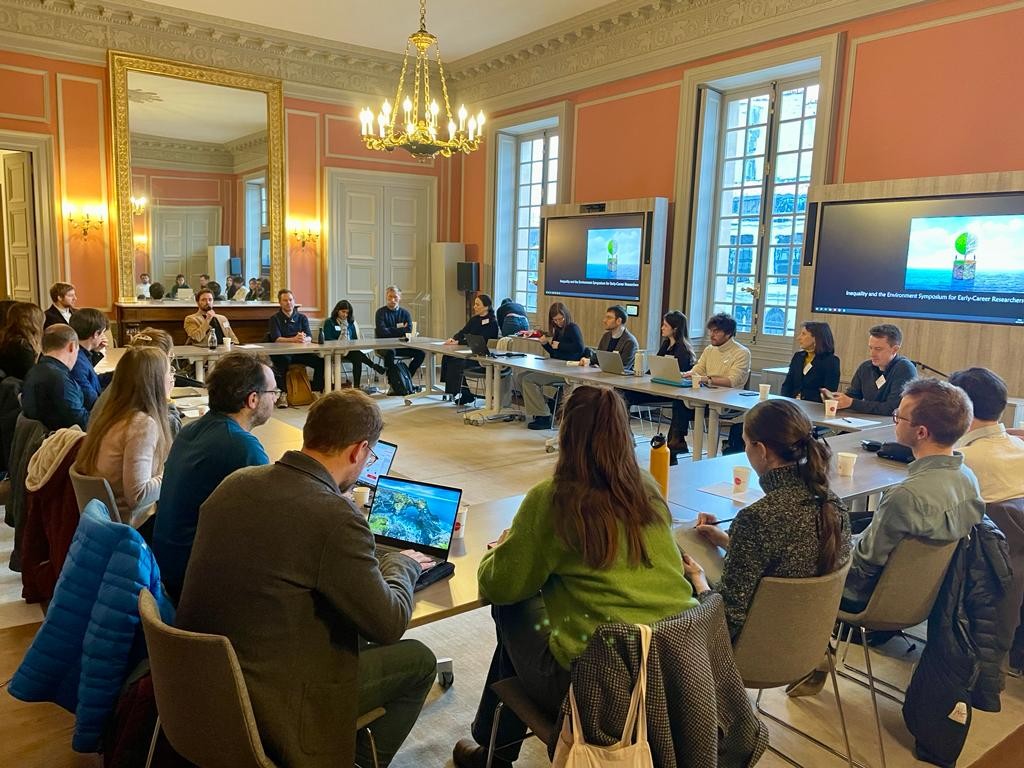
Joint meeting today at sciences Po with the World Inequality Lab & The Malcolm Wiener Center for Social Policy. +20 early-career researchers unraveled inequality and the environment degradation interplay https://www.sciencespo.fr/osc/fr/content/inequality-and-environment-symposium-early-career-researchers-0.html
"The World in Numbers: Inequality". Lucas Chancel presentation (30 min.), World Economic Forum 2024, 16 January, 15:00 CET. This session delves into the multiple dimensions of global inequality, its social and economic costs, and the policy choices to address these challenges. https://www.weforum.org/events/world-economic-forum-annual-meeting-2024/sessions/the-world-in-numbers-inequality
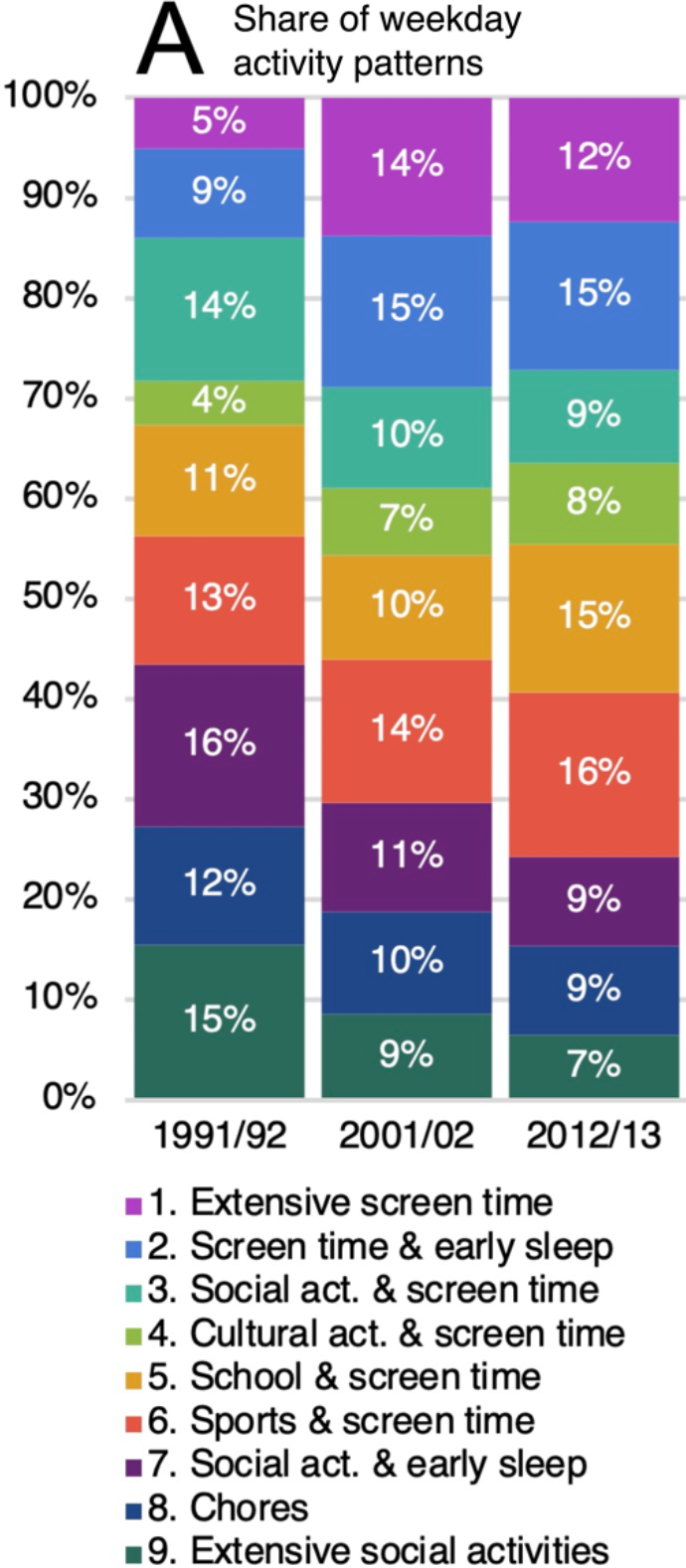
Screen-time, cultural activities, sport, schoolwork... "Change and inequality in German teenagers’ typical time-use sequences between 1991 and 2013" -> preprint by @betthaeuser, M. Siglreitmaier & A. Fasang. Results provide new evidence corroborating existing theories of social stratification of children’s time use & increased time spent on screen activities. https://osf.io/preprints/socarxiv/25dkj
Call for presentation: "Women in Times of Crisis: Rethinking the Extraordinary and the Everyday" - Online Conference (Alliance Columbia University, Sciences Po, Panthéon Sorbonne University) - Deadline: January 15th.
Climate change - global pandemic - conflicts - radicalization - demographic shocks (fertility, migrations...) - economic change (AI...)
www.sciencespo.fr/osc/en/conte...
"The temporal dimension of parental employment: Temporary contracts, non-standard work schedules, and children’s education in Germany", Paper by @betthaeuser, @natrinh, A. E. Fasang. https://doi.org/10.1093/esr/jcad073 Children whose mother always works evenings or Saturdays are substantially less likely to transition to the academic school track...
How ready were governments and the public to sacrifice thousands of lives to avoid economic collapse during the pandemic? "Understanding public attitudes during Covid‑19 in France with Polanyi and Gramsci: a political economy of an epidemiological and economic disaster", Paper by Emanuel Ferragina (et al.) https://link.springer.com/article/10.1057/s41295-023-00369-x
Interested in family sociology, demography as well as quantitative methods?
Join the CRIS at Sciences Po Paris. We're hiring 2 PhD students in sociology, economics, gerontology... Project "A Social Demography of Widowhood across Ageing Societies" - Deadline 10 December. info : https://www.sciencespo.fr/osc/sites/sciencespo.fr.osc/files/WIDOW_PhDs_13_112023.pdf